
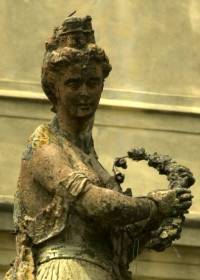
Santa Maria Cattolica Maggiore boasts a statue done by Andrea Cefaly around 1870 called Italia pictured at the top of this page. The statue of a woman represents Italy and you will notice her back is to the church. This was a political statement representing the separation of politics from faith. It was a strong and popular sentiment around the time of the unification of Italy. At one time there were a number of churches in Cortale. Today only 3 are in use. They are Santa Maria Cattolica Maggiore, Chiesa Matrice di Santa Maria Cattolica and Chiesa di San Giovanni Battista.
 Listed blow are related pages on this site that may be of interest.
There are currently several websites with Catanzaro records online. I have listed a few beow.
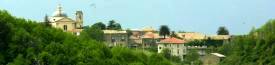
 Cortale is the village of my grandmother, Caterina Maiuolo. It is located near the comuni of Maida and Jacurso. Cortale is divided into two sections Upper Cortale (also called Donnafiore) and lower Cortale also called Cortale Inferiore. Pronounced Cortala, this comune has a proud heritage of art. Cortale's most famous citizens is Andrea Cefaly an artist whose art hangs in The Lourve in Paris among other places. The Cortalesi are proud of their heritage and this small comune has roots going back to the days of the Roman Empire. The Patron Saint of Cortale is St. John, the Baptist.
The road to "Upper Cortale" is a long winding treacherous road. As you approach the top a small shrine appears on the roadside containing a small statue of the Madonna. This is called "Donnafiore" but no one knows how it got that name. Speculation that it was the name of the woman who built the shrine cannot be confirmed. "Donna" in Italian is not a name but a title meaning "lady". Fiore is a man's name and a surname which also means flower. No one will ever know for sure, but at one time this small shrine was important in the town and the immigrants who left Cortale visited it before leaving. Beyond the statue is a beautiful panoramic view of "upper Cortale" and the Mother Church amidst the lush green hills.
Cortale was especially hard hit by the mass emigration from about 1880 through the 1920's. Once a large bustling town with a population close to 6,000 it now has 2,772 citizens. My grandmother's family came from this comune. Most of her family left Cortale during the mass immigration period. Many of my grandparents neighbors in the Chicago area came from Cortale. Nellie Bilotta a good friend of my grandmother and great aunt was a neighbor in Cicero, Illinois and Cortale. A list of immigrants from Cortale (in Excel spreadsheet format) can be accessed here.
The Holy cross The inhabitants of Cortale tell a story that explains their devotion to the Holy Cross. It is said that while ploughing the land, something very strange happened to a peasant. He realized that his oxen were kneeling at a certain spot on his land, and decided to find out why. In the very spot where the animals were stopping he found a strange stone cross with miraculous properties. For this reason the Church of Santa Croce was built there.
Poor Betta's Oak Another Cortale legend says that years ago in Cortale a violent gang of bandits lay in hiding in the Spano area and robbed and hanged travelers. One day the gang leaders mother, who was deeply saddened by her son's cruelty, thought it better to have a son who was dead rather than one who was a bandit. So she decided to poison him. At dinnertime she served an omelet made of poisonous herbs. But the her son, becoming suspicious, made his dog taste it. After a few moments the animal dropped dead. The bandit ordered his mother to be hanged from the highest oak tree in the village. And to this day it has been called "Poor Betta's oak".
Back To Cortale Mayors »
2007-2012 © Calabrian Genealogy.com
C. Napolitano, Webmaster
Design by raykdesign | Valid CSS and XHTML Valid
|
